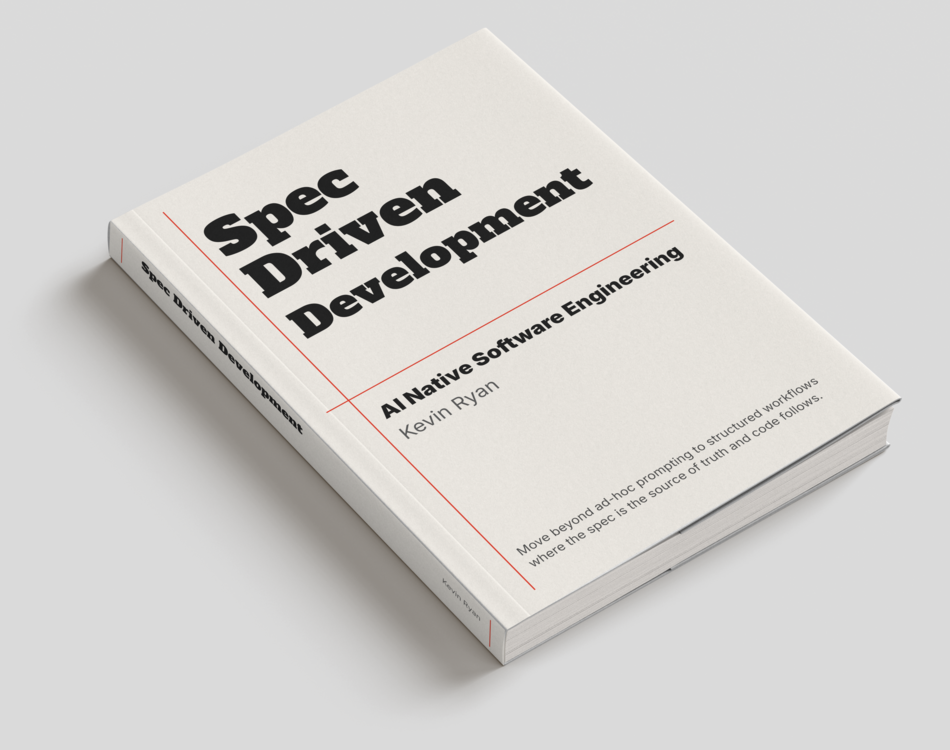
Spec Driven Development
AI Native Software Engineering
Move beyond ad-hoc prompting to structured workflows where the spec is the source of truth and code follows.
AI Native Software Engineering
Move beyond ad-hoc prompting to structured workflows where the spec is the source of truth and code follows.
Code is a side effect.
SDD inverts traditional software development when working with AI coding agents. Instead of think, code, document — you specify, generate, validate. The specification is the primary work product. Generated code is a derived output that can be regenerated, revised, or discarded.
This is not prompt engineering. Prompts are tactical. SDD is a professional methodology — an architectural pattern that makes specifications executable and enforceable. It draws on BDD, TDD, and contract-first development while addressing the new challenges of AI-assisted generation.
If your experience of AI coding has been vague prompts producing mediocre code, over-detailed prompts still producing wrong code, and occasional successes you cannot replicate — this book provides the systematic approach you're looking for.
Professional software developers already using AI coding tools who want a repeatable system, not tips and tricks. Assume three or more years of development experience and a healthy scepticism of AI hype.
This book is written using its own methodology. Content, editorial voice, and brand identity are governed by specifications served to the AI agent via Model Context Protocol servers at authoring time.
.spec
Book briefs, chapter outlines, editorial rules, and content specifications. The source of truth for what gets written.
.skills
Relevant capabilities and tooling context. Ensures the AI agent has the right knowledge to execute against the spec.
.brand
Tone, voice, and positioning rules. Keeps every generated word on message — professional, grounded, never hypey.
Every chapter begins with the same workflow the book teaches. The .spec server loads the book brief, chapter outline, and editorial constraints. The .skills server provides the agent with relevant capabilities. The .brand server enforces tone, voice, and positioning rules. The AI agent writes against these specifications — not from a blank prompt.
The output is validated against the spec before it's committed. Does it match the chapter's declared scope? Does the voice hold? Does it contradict anything established elsewhere? This is the specify–generate–validate loop the book describes, applied to its own prose.
On merge to main, the publication pipeline takes over. It determines a build reference — a version tag or commit SHA — and injects it into the cover SVG and the copyright page of every format. The cover, the PDF, and the EPUB are rendered, validated, and deployed to Azure Blob Storage. No manual intervention between commit and publication.
Pick up any copy and you know exactly what state of the repository produced it. That's not decoration. It's traceability — the same principle the book advocates for production software. Non-deterministic generation, deterministic validation, automated deployment. The book's methodology applied to its own creation.
The book teaches the methodology. The skill makes your agent follow it. Install it and your AI coding agent starts working with specifications, decision gates, and provenance — the same workflow described in every chapter.
Published on the Tessl Registry as a versioned, evaluated skill. One command to install. No configuration. Works with Claude Code, Cursor, Windsurf, and any MCP-compatible agent.
The skill includes the complete two-loop workflow, the step 6 decision gate, spec format requirements, the four types of context, provenance tracking, and a reference library of practitioner-discovered principles and anti-patterns. Everything in the book, distilled into structured context your agent can act on.
 View on Tessl Registry
Kevin Ryan has spent thirty years in software engineering, starting with code and moving through architecture, agile adoption, DevOps, and platform engineering. He adopted XP, TDD, and continuous integration in the late 1990s, agile and Scrum in the early 2000s, and infrastructure as code and DORA metrics as they emerged — each time before the practices became mainstream.
He has delivered platform engineering and CI/CD programmes for CERN, Nestlé, BBC Worldwide, the Financial Times, and Dematic, among others. At a leading UK bank, he led the enterprise AI-assisted development pilot and delivered board-level recommendations on AI adoption.
His previous book, AI Immigrants: The Bloody Algos Are Here!, examined the cultural, economic, and moral upheaval of intelligent machines.
He is based between London and Budapest.